

Summary
Most blockchains use a global mempool with peer-to-peer gossipping for transaction propagation. This approach is not suitable for high-performance distributed consensus for a few reasons:- It is slow because it may involve many hops for a transaction to reach a leader, increasing time to inclusion.
- It is wasteful on bandwidth because the gossip protocol involves many retransmissions.
- It ignores the leader schedule which is typically known well in advance.
Background
A mempool is a collection of pending transactions. Many blockchain networks use a global mempool design, using peer-to-peer gossip protocols to keep roughly the same mempool state across all nodes in the network. A primary motivation of a global mempool design is that no matter who is leader, they will have access to the same set of pending transactions to include in the next block. A global mempool is effective for low-throughput networks, where network bandwidth is typically not a bottleneck. However, at thousands of transactions per second, the gossip protocols (and especially the required retransmission at each node) can easily consume the entire network bandwidth budget. Moreover, a global mempool is wasteful since the leader schedule is typically known well in advance.Transaction Lifecycle in Monad
There is no global mempool in Monad. Validators maintain local mempools; RPC nodes forward transactions to upcoming leaders to ensure that those transactions are available for inclusion. More precisely, transaction flow is as follows:- A transaction is submitted to the RPC process of a node (typically a full non-validator node). We’ll call this node the “owner node” of the transaction, since it assumes responsibility for communicating the status with the user.
- The RPC process performs some static checks on the transaction.
- The RPC process passes the transaction to the consensus process.
- The consensus process performs static checks and dynamic checks against local state in MonadDb, such as checking the sender’s account balance and nonce.
- If the transaction is valid, the consensus process forwards the transaction to
Nupcoming leader validator nodes. Currently,Nis set to 3 in Monad testnet and mainnet. - Each of those
Nvalidators performs the same checks before inserting valid transactions into their local mempools. - When it is a leader’s turn to create a proposal, it selects transactions from its local mempool.
- The owner node of the transaction monitors for that transaction in subsequent blocks. If it doesn’t see the transaction in the next
Nblocks, it will re-send to the nextNleaders. It repeats this behavior for a total ofKtimes. Currently,Kis set to 3 in Monad testnet and mainnet.
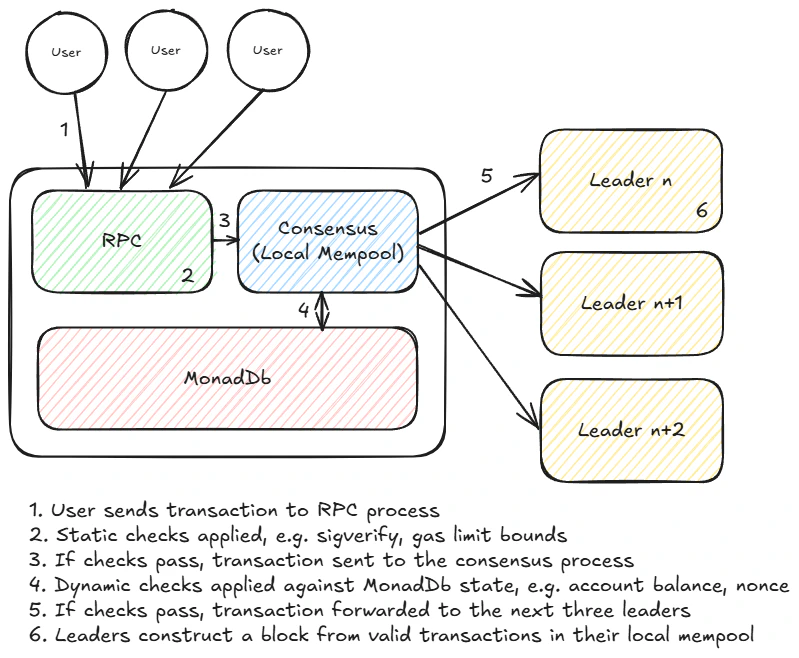
Transaction path from RPC to leader (through the local mempool).
Local mempool eviction
Transactions are evicted from a validator’s local mempool for the following reasons:- Whenever a validator finalizes a block, any replicas of transactions in that block are pruned from the local mempool.
- Validators periodically check the validity of each transaction in the mempool and evict invalid transactions (e.g. nonces are too low, account balances are insufficient).
- If the local mempool’s size reaches a soft limit, older transactions will be evicted.