

Summary
Statesync is the process for synchronizing state to a target block close to the current tip. A synchronizing node (“client”) requests data from other up-to-date validators (“servers”) to help it progress from its current view to its target view; the servers rely on metadata in MonadDb to efficiently respond to the request. Since the current tip is a moving target, following completion of statesync, the client makes another statesync request to get closer to the current tip, or replays queued blocks if within striking distance.Approach
Statesync is the process of synchronizing state stored in MonadDb to a target block close to the current tip. The current tip is a moving target, so as statesync is running, the syncing node stores new blocks beyond the target block and, upon completion of statesync, replays these additional blocks through normal execution to catch up to the current tip. The target block may be updated several times during this process. Statesync follows a client-server model, where the statesync requester is the client and the validator node servicing a statesync request is the server.Data included in statesync
MonadDb stores a variety of data relating to the execution of blocks. However, only a subset is required for full participation in the active set and thus included in statesync:- accounts, including balances, code, and storage
- the last 256 block headers (to verify correctness)
Versioning and verification
For efficiency, the client requests state from least- to most-recently updated, converging on the tip near the end of the process. Servers serve diffs relative to the client’s latest block.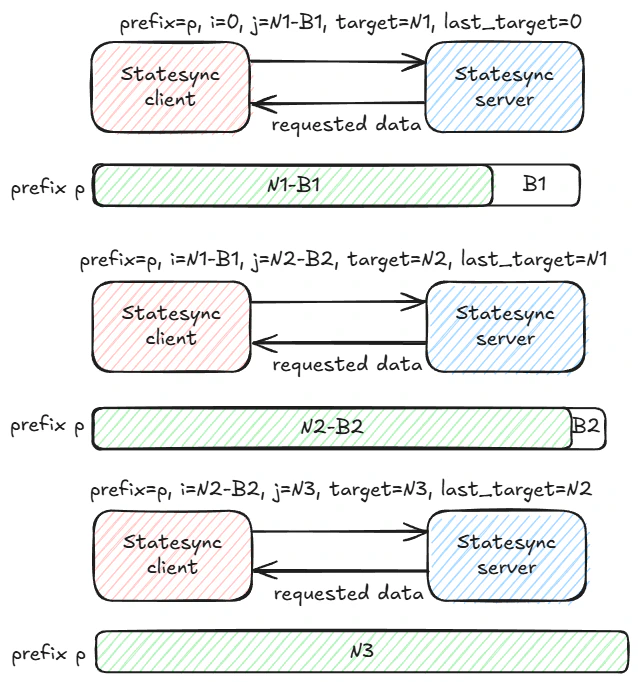
prefix- the prefix of the Merkle Patricia Triei- the start block numberj- the end block numbertarget- the target block numberlast_target- last target block number, this is used to deduce deletions to send
j is buffered by some offset B from the target block to avoid retransmitting most recently used nodes in the MPT. When i and target block are sufficiently close, as in the last round above, the statesync client will request j = target.
At this point, if target is less than statesync_threshold (600 blocks by default) from the tip of the chain, statesync is concluded and the state root will be validated. Any remaining blocks between target and tip are then synced via blocksync. If target is greater than statesync_threshold blocks from the tip of the chain, a new round of statesync will begin.
During block execution, the server stores the version alongside node contents. As such, upon receipt of a statesync request, the server is able to quickly narrow down the relevant subtrie and submit read requests, which are embarrassingly parallel.