

What’s familiar about Monad?
From a user perspective, Monad behaves very similarly to Ethereum. You can use the same wallets (e.g. Phantom, MetaMask) or block explorers (e.g. Etherscan) to sign or view transactions. The same apps built for Ethereum can be ported to Monad without code changes, so it is expected that you’ll be able to use many of your favorite apps from Ethereum on Monad. The address space in Monad is the same as in Ethereum, so you can reuse your existing keys. Like Ethereum, Monad features linear blocks, and linear ordering of transactions within a block. Like Ethereum, Monad is a proof-of-stake network maintained by a decentralized set of validators. Anyone can run a node to independently verify transaction execution, and significant care has been taken to keep hardware requirements minimal.What’s different about Monad?
Monad makes exceptional performance possible by introducing parallel execution and superscalar pipelining to the Ethereum Virtual Machine. Parallel execution is the practice of utilizing multiple cores and threads to strategically execute work in parallel while still committing the results in the original order. Although transactions are executed in parallel “under the hood”, from the user and developer perspective they are executed serially; the result of a series of transactions is always the same as if the transactions had been executed one after another. Superscalar pipelining is the practice of creating stages of work and executing the stages in parallel. A simple diagram tells the story: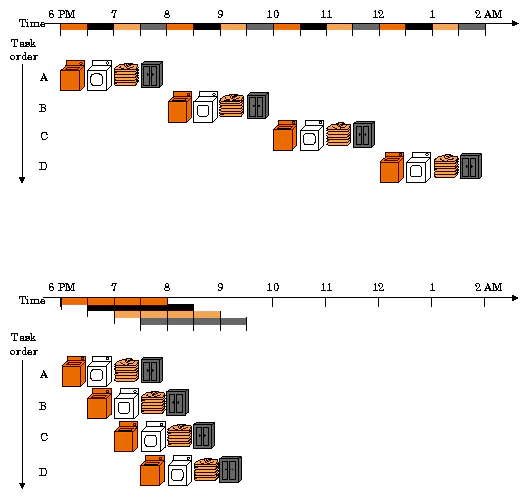
Pipelining laundry day. Top: Naive; Bottom: Pipelined. Credit: Prof. Lois Hawkes, FSU
When doing four loads of laundry, the naive strategy is to wash, dry, fold, and store the first load of laundry before starting on the second one. The pipelined strategy is to start washing load 2 when load 1 goes into the dryer. Pipelining gets work done more efficiently by utilizing multiple resources simultaneously. Monad introduces pipelining to address existing bottlenecks in state storage, transaction processing, and distributed consensus. In particular, Monad introduces pipelining and other optimizations in five major areas:- MonadBFT for performant, tail-fork-resistant BFT consensus
- RaptorCast for efficient block transmission
- Asynchronous Execution for pipelining consensus and execution to raise the time budget for execution
- Parallel Execution and JIT Compilation for efficient transaction execution
- MonadDb for efficient state access
Why should I care?
Decentralized apps are replacements for centralized services with several significant advantages:- Open APIs / composability: decentralized apps can be called atomically by other decentralized apps, allowing developers to build more complex functionality by stacking existing components.
- Transparency: app logic is expressed purely through code, so anyone can review the logic for side effects. State is transparent and auditable; proof of reserves in DeFi is the default.
- Censorship-resistance and credible neutrality: anyone can submit transactions or upload applications to a permissionless network.
- Global reach: anyone with access to the internet can access crucial financial services, including unbanked/underbanked users.